 pSeven Enterprise
dns On‑premises cloud Private cloud
Agentic AI toolkit
AI agents are beginning to operate engineering software autonomously. The question is not whether this will affect simulation-driven engineering – it is whether your tools are ready to be called by an agent. pSeven Enterprise is built to be. Your simulation expertise, already captured in workflows and apps, becomes directly accessible to AI agents through standardized interfaces - without rebuilding or rewrapping anything.

What does agentic AI mean for engineering?
AI agents are LLM-based software systems that plan, decide, and act across multiple steps to reach a goal – calling tools, reading results, and adjusting their approach along the way, without a human directing each move. In engineering, this means an agent can be given a high-level objective and autonomously navigate the software, data, and decisions needed to get there. The gap between that promise and practical reality has always been the same question: how does the agent reach the tools? Simulation software does not come with a chat interface. Solvers do not respond to natural language. Until an agent can reliably call, monitor, and chain engineering tools, it remains a capability that lives in demonstrations rather than in real workflows.
New to AI in engineering automation?
Read our article "ABCs of AI in engineering automation" that is specifically created to help people who are just beginning to explore AI technologies in engineering, or who do not yet have a thorough understanding of them, to better understand their scope of application, limitations and prospects.
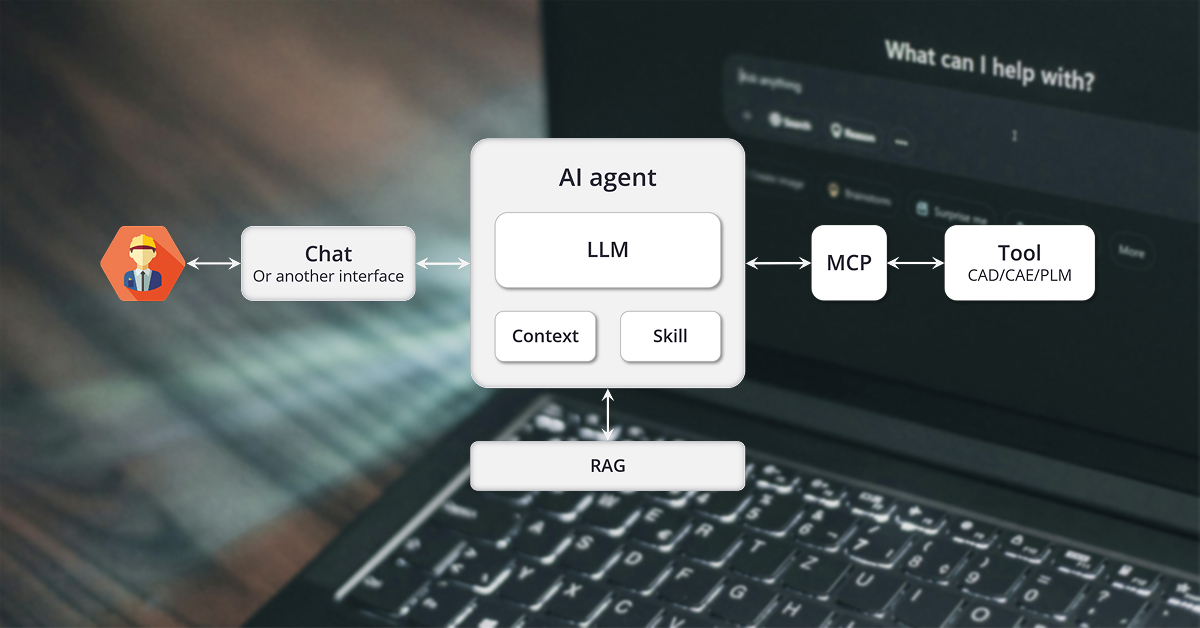
How pSeven Enterprise fits in?
Agentic AI toolkit in pSeven Enterprise sits at the point where engineering expertise is already formalized – in workflows that capture simulation processes and in apps that expose them to users. Rather than requiring teams to rebuild that expertise in a new form for AI consumption, pSeven Enterprise exposes it through MCP, a standardized protocol that any compatible AI agent can connect to. The result is a direct bridge between the agent and your simulation environment: the agent discovers what tools are available, understands their inputs and outputs, and calls them as part of a larger automated task. Your workflows remain exactly as they are; what changes is that an AI agent can now use them as fluently as a human user can.
What AI agents can do
in pSeven Enterprise
The agentic AI toolkit in pSeven Enterprise is organized into three layers. The first makes your published simulation apps callable by an agent through a natural language interface. The second embeds AI reasoning inside workflows themselves, giving them the ability to handle variability without breaking. The third opens workflow authoring and management to the agent directly, enabling fully autonomous engineering cycles. Each layer is independent – you can adopt the first without committing to the others.
Execute and chain simulation apps
via chat interface in natural language
Once connected, an AI agent operates within pSeven Enterprise either with the same access rights as the user who established the connection or intentionally limited to a certain degree. It can browse available apps, inspect what inputs they require and what outputs they produce, run them with values it determines or receives from a previous step, and pass results forward into the next stage of a pipeline – all driven by natural language instructions from the engineer. A task that previously meant manually navigating the interface, configuring inputs, waiting for results, and feeding them into the next tool can now be delegated to an agent in a single prompt. The engineer stays in control of what gets approved and acted on; the agent handles the execution mechanics.
Discover and inspect
An agent can find available apps and workflows, read their inputs and outputs, and decide which ones to call.
Execute and chain
Run apps with custom inputs, pass one run's output as another's input, and build multi-step automated pipelines.
Monitor and recover
Track running jobs, catch failures, interrupt or restart runs without human intervention.
Available now
Introduce process tolerance in workflows
with non-rigid automation
Real engineering workflows encounter variability that rigid automation cannot handle – unexpected output formats, missing fields, unit inconsistencies between connected tools, solver results that require interpretation before the next step can proceed. Agentic-ready blocks for Studio embed AI reasoning directly inside workflows to resolve these situations without halting execution or requiring manual intervention. An AI block can read ambiguous output, infer the correct interpretation, reformat data to match the downstream input, or flag an issue with a structured diagnosis rather than a silent failure. This is the difference between automation that breaks at the edges and automation that handles them.
Available on request
Build and execute workflows
via chat interface or autonomously in agentic cycles
The MCP server for Studio extends agentic access beyond app execution to workflow authoring and management itself. An agent connected to Studio can assemble workflows, configure blocks, execute runs, and publish them as apps in AppsHub – operating in full agentic cycles where each iteration informs the next. This enables scenarios where the agent is not just running a predefined process but actively building and refining one in response to intermediate results, effectively acting as an engineering automation assistant that works at the workflow level rather than the task level. This capability is available on request for early adopters working with us to validate the approach in real engineering environments.
Available on request
Accelerate adoption of agentic AI
with a variety of agentic-ready blocks
Whether you are starting with AppsHub execution, adding agentic-ready blocks to existing workflows, or exploring Studio-level automation, our Marketplace provides ready-to-use building blocks for each layer. The Agent block, the Agentic App Reference, and the Agentic DSE block are available now and cover the most common entry points for teams getting started.

Agent
LLM agent that calls other workflow blocks as tools. Give it a task on User prompt; it plans, calls the tools you wired, and answers on Response.

Agentic App Reference
References a published AppsHub app and runs it as a block - the agentic analog of the built-in App reference block.

Interested in agentic AI for your engineering workflows?
We are actively developing this capability and working with early adopters. If you want to explore what agentic automation could look like in your simulation environment, let's start the conversation.