 pSeven Enterprise
dns On‑premises cloud Private cloud
Web-native low-code platform for design exploration and automation of engineering processes at scale:
- Automate simulation workflows and find optimal designs right in your browser.
- Collaborate easily with teammates within your organization and partners.
- Scale even resource-intensive trade-off simulation studies.
- Create and share workflow-powered web apps.
Brochure picture_as_pdf Marketplace Documentation Deployment Licensing Get demo access

All you need to automate engineering processes at scale

- Multi-user environment - Workflow co-authoring and sharing in the browser.
- Low-code automation - Web-native architecture and documented open API.
- Workflows as web apps - Workflow-powered web apps in few clicks.
- Workflow engine - Visual and executable representation of processes.
- Machine learning - Build and deploy fast and reliable ML models.
- Resource management - Execution in distributed heterogeneous environment.
- Optimization - Explore, optimize and calibrate your models.

Capture and transfer knowledge
- Formalize complex multidisciplinary engineering processes at scale.
- Share, reuse and maintain knowledge with low-code approach.

Automate repetitive tasks
- Accelerate product development cycle through productivity gain.
- Reduce time-to-market with standardization and democratization.

Find optimal designs
- Optimize your designs easily with automatic algorithm selection.
- Predict behavior of new designs with advanced Machine Learning techniques.
Customer success stories


- Subsea field design automation (project ARENA)
- 3x time reduction of the project design justification


- Enabling digital oilfield applications (Digital Field Solver)
- Many oil & gas customers worldwide
Explore industrial use cases
Automation of hybrid electric vehicle design process using Aras Innovator and pSeven Enterprise
Explore pSeven Enterprise's capabilities as a collaborative platform for formalizing and automating multidisciplinary fuel consumption analysis of hybrid electric motors. It presents this process as a ready-to-use, verified tool and demonstrates the platform's integration capabilities and the effective use of the tool within the Aras Innovator PLM system.
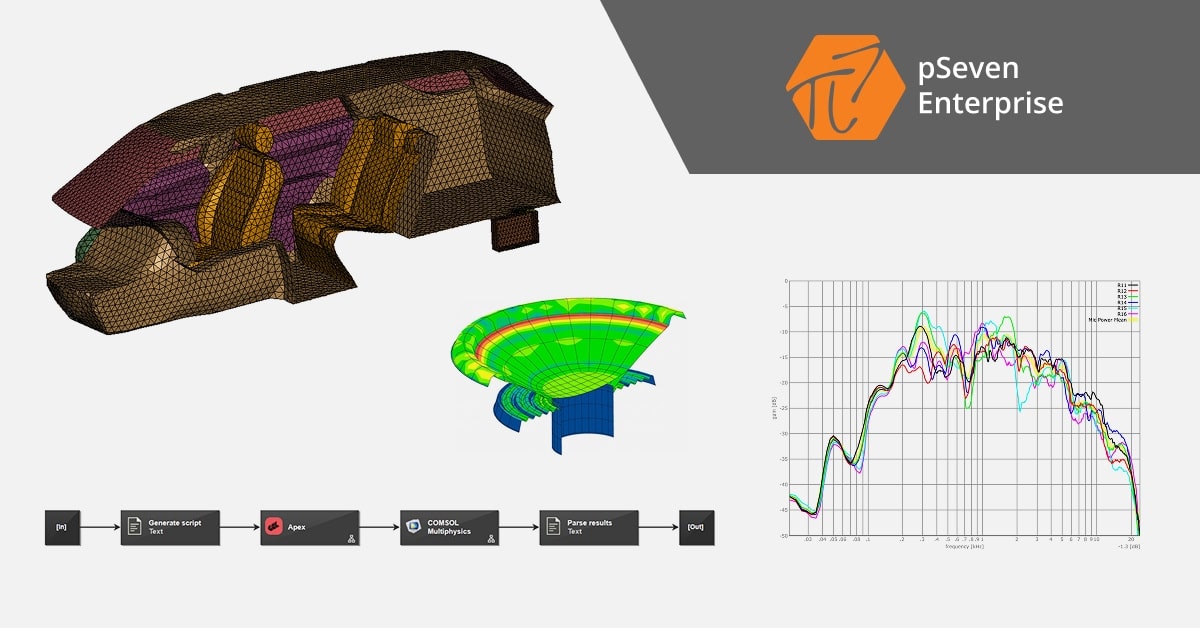
Streamlining NVH analysis of loudspeaker performance
Find out how predictive modelling techniques and engineering solutions are shaping the future of automotive acoustics. Explore a web-based application that automates the evaluation of loudspeaker positioning within vehicle interiors. This application enables quick design iterations, reduces manual effort and assists non-experts in making informed audio design decisions.
Fully automated car suspension simulation process in pSeven Enterprise
pSeven Enterprise transforms complex simulation business processes into automated multidisciplinary workflows. This transformation formalizes processes, eliminates data transfer errors and accelerates simulation. Furthermore, automated simulation workflows enable parametric, multidisciplinary design optimization.

Capture complex engineering processes
with low-code workflow automation
pSeven Enterprise allows to capture even the most complex engineering processes, define its logic and collect, analyze and reuse engineering data thanks to powerful workflow engine and low-code approach. Additionally, users can download a variety of ready-to-use integration and functional blocks directly from our Marketplace to accelerate automation of their processes.
Collaborative engineering
and workflow co-authoring in real-time
pSeven Enterprise is a multi-user platform with simultaneous access and co-authoring of the workflows in the browser. Shared workspaces are designed for departments or teams to share and edit workflows, results and files depending on the user roles - all in your browser in real-time.

Share simulation methodologies
as workflow-powered web apps
Workflows in pSeven Enterprise can be easily published and shared in a form of web apps with either automatically generated or custom developed GUI. These workflow-powered web apps serve as easy-to-use engineering calculators that hide unnecessary complexity and democratize the use of best practices for inexperienced users.
 Some examples of possible integrations
Boost PLM / SPDM systems
with enhanced simulation workflow execution
As a collaborative engineering platform, pSeven Enterprise is designed for automating complex simulation workflows and executing them server-side. All workflows are executed server-side in various predefined runtime environments with scalable resource management. All of that makes pSeven Enterprise a reliable backbone for PLM / SPDM systems in terms of handling simulation workflows.
Explore design alternatives
and find optimal designs
pSeven Enterprise is equipped with a set of tools to efficiently explore model behavior using a wide range of Design of Experiments (DoE) techniques, solve multi-objective optimization problems and perform Uncertainty Quantification (UQ) studies with both fast-to-evaluate analytical models and computationally-expensive simulations.
By creating predictive models*, existing test, experimental, and/or simulation data can be used to predict response values for new designs, accelerate complex simulations by many orders of magnitude and capture essential knowledge.
* - Also often called machine learning models, response surface models (RSM), reduced order models (ROM), approximation models, surrogate models, metamodels etc.
 Design Exploration
Explore various design alternatives and easily find optimal solutions with Design of Experiments and Design Optimization strategies.
 Uncertainty Quantification
Improve quality and reliability of designed products and manage potential risks at early design, manufacturing and operating stages.
 Predictive Modeling
Predict response values for new designs, accelerate complex simulations and capture knowledge by creating fast models from data.
 Automatic choosing of algorithms in all tools thanks to SmartSelection technology
What's new in pSeven Enterprise?
In pSeven Enterprise, a workflow is not only an engineering methodology, but also the history of its development. The latest update to pSeven Enterprise allows you to save important stages in the evolution of the methodology as separate workflow versions, known as 'snapshots'.
These stages may include the initial workflow draft, an intermediate version with test simulation models, a final version with real simulation models and the published version as a web application on AppsHub.

As well as saving important stages of the workflow's development, snapshots also save the corresponding files. This makes it possible to have a complete, reproducible and always accessible version of the entire engineering process.
The update also enables you to compare workflow snapshots with each other and provides a visual representation of all the changes made, such as added blocks, updated port values, block connections and new files. This comparison provides a clear overview of the differences between any snapshot and the current workflow version.

pSeven Enterprise is a living environment that functions as an R&D workshop. It is pre-equipped with essential tools and can be shaped to enforce company standards, from UI logos to domain-specific tools that preserve and refine established design practices.
Post-processing tools are essential for engineering studies, providing plots and graphs of data samples and 3D visualizations of geometry or simulation results. In line with the idea of capturing methodology, these visual analysis tools should be flexible enough for experts to set up and easy to share with other users for effective everyday work.

v2026.02 release enables M&T experts to build tailored pre- and post-processing tools for specific types of analysis or data formats. These tools can then be made available to everyone in the organization, ensuring that standards are implemented system-wide.
We also provide default viewers for typical scenarios, such as analyzing a data sample over a .csv file, inspecting a predictive model, or visualizing 3D geometry. These viewers are useful as they are, but they can also be used as a reference implementation for custom modifications.
Future releases will add to the list of embedded post-processing tools, providing more options for one-click data or results exploration.

Block publishing process
Development of custom blocks is a powerful and popular way to extend and tailor pSeven Enterprise to address and streamline everyday usage efficiency for each customer scenario. With recent updates, we significantly simplified the process of block publishing. Now the author of the block does not need any assistance from the deployment administrator to publish the block to Common library to make it assessable by all users on the deployment – only proper permissions. And the process of publication is now reduced to simple drag-and-drop of the block from personal library to common one in the user interface, yet preserving all advantages of block versioning, tagging and grouping.
User setup
Since the recent version of pSeven Enterprise, deployment administrators can tune the user account even before the first login happens – user is initialized upon creation. This improvement saves time and effort and ensures no problems with an unexpected increase in license count, wrong initial permissions, etc.
Moreover, user account creation and modification are now fully covered by public API – which enables even more tight integration of pSeven Enterprise into existing ecosystems.
Workflow export \ import API
In production deployments there is often a need to automatically backup some workflows to external storages, re-import them from such storages or even transfer the workflows from one deployment to another in an automated way. All of those are now possible with the recent API extension.
Go to page navigate_next
Download an eBook by CIMdata
The eBook highlights the challenges industrial companies of all sizes face in deploying simulation across domains and how pSeven Enterprise addresses those challenges.