April 2, 2026
QUGATE brings its smart analysis tools to pSeven Enterprise Marketplace
We are excited to announce that four powerful new analysis blocks from our partners at QUGATE are now available on the Marketplace! They bring advanced statistical and optimization capabilities directly into pSeven Enterprise workflows, helping you build more robust and efficient designs.
Modern engineering increasingly relies on high-fidelity simulations that are accurate but computationally expensive. In many real-world projects, running enough simulations to fully explore uncertainty or design trade-offs simply isn't feasible and the cost and time of each additional run is a challenge every engineering team knows well.
That's why QUGATE's analysis blocks are built around a core principle: do more with less. Every block is designed to extract maximum insight from a minimal number of simulations, so engineers can quantify uncertainty and make confident design decisions without the burden of brute-force exploration. Fewer runs, deeper understanding.
These tools are developed to fit seamlessly into existing engineering workflows. They offer direct compatibility with the standard Design Space Exploration block, allowing you to take the results of an initial Design of Experiments and instantly transform that raw data into deep, meaningful insights. Each block produces a rich report as its primary output, enabling you to explore results interactively.
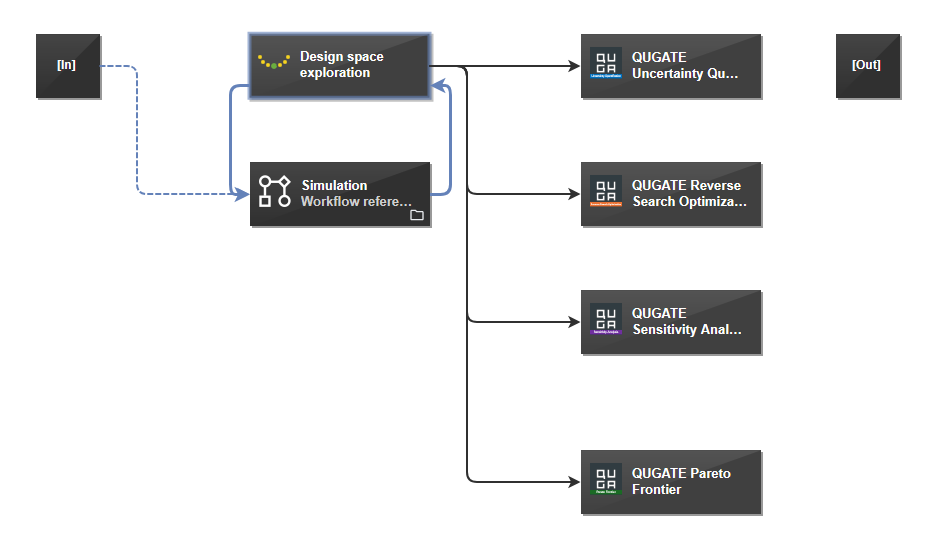
Here is an overview of these new blocks and the value they can bring to your projects:
1. Uncertainty Quantification
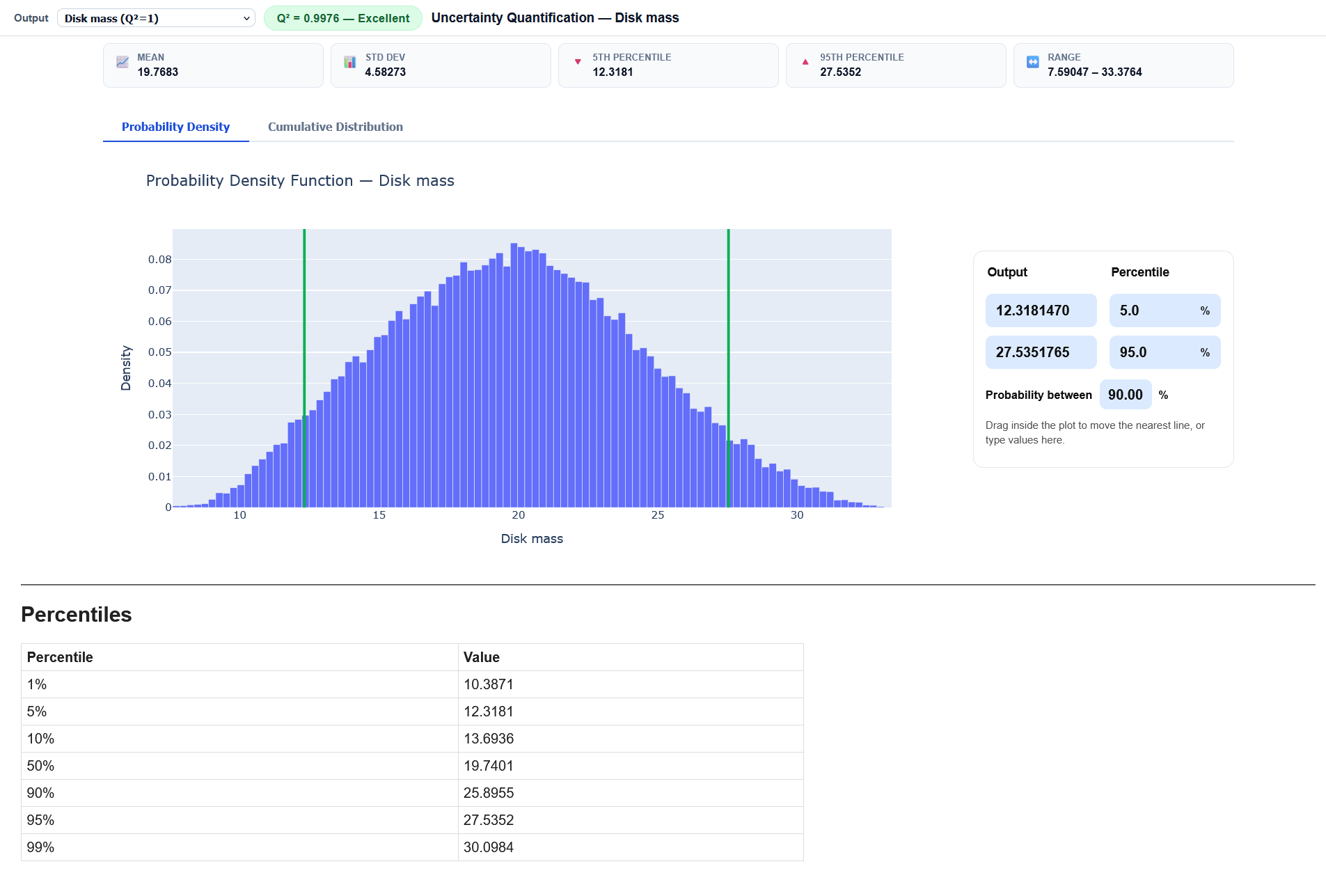
- What it does: This block predicts the probability distribution of your model's outputs based on the uncertainty of its inputs. It applies an "Adaptive Generalized Polynomial Chaos Expansion" (agPCE) algorithm to create a high-fidelity surrogate model from your sample data and uses it to generate a probability density function, cumulative distribution and a percentile table for each output.
- Why this is useful: It allows you to assess the reliability of your design and understand the statistical risk of failing to meet performance targets. You get detailed insights into output variability, including mean, standard deviation, and confidence intervals. On top of that you can define your own performance bounds to directly evaluate how much of your output distribution meets your specific requirements.
2. Sensitivity Analysis
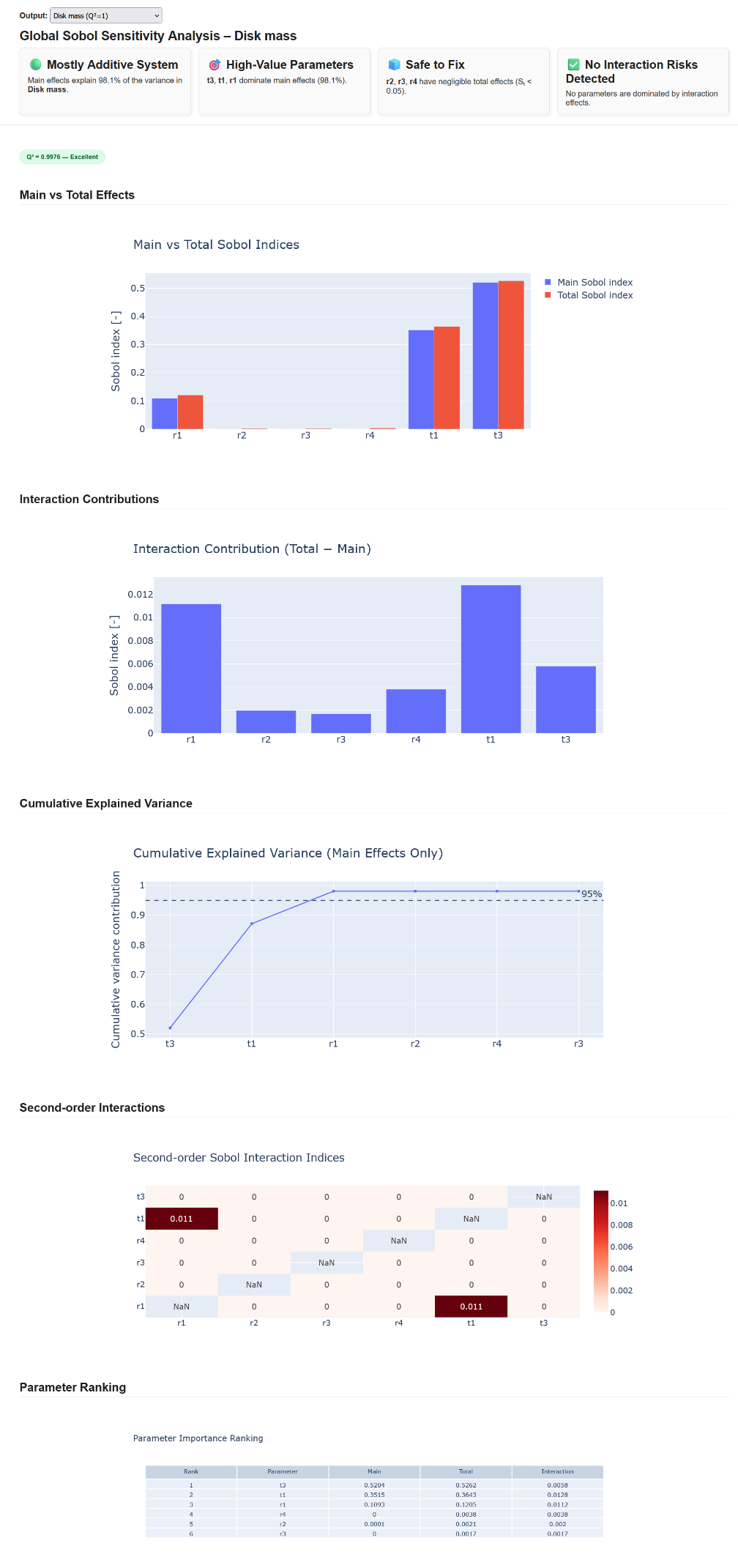
- What it does: This block identifies which input parameters have the most significant impact on your model's outputs. It uses the same technique to build a surrogate as the previous block and uses its polynomial coefficients to analytically calculate Sobol indices and rank the inputs based on their individual and interactive effects on system performance.
- Why this is useful: It helps you focus your engineering efforts on the "drivers" that are significant while identifying "noise" parameters that can be simplified or ignored. This is essential for guiding which inputs to tighten or refine to reduce overall output variability, as well as simplifying your model by retaining only the most important drivers.
3. Reverse Search Optimization
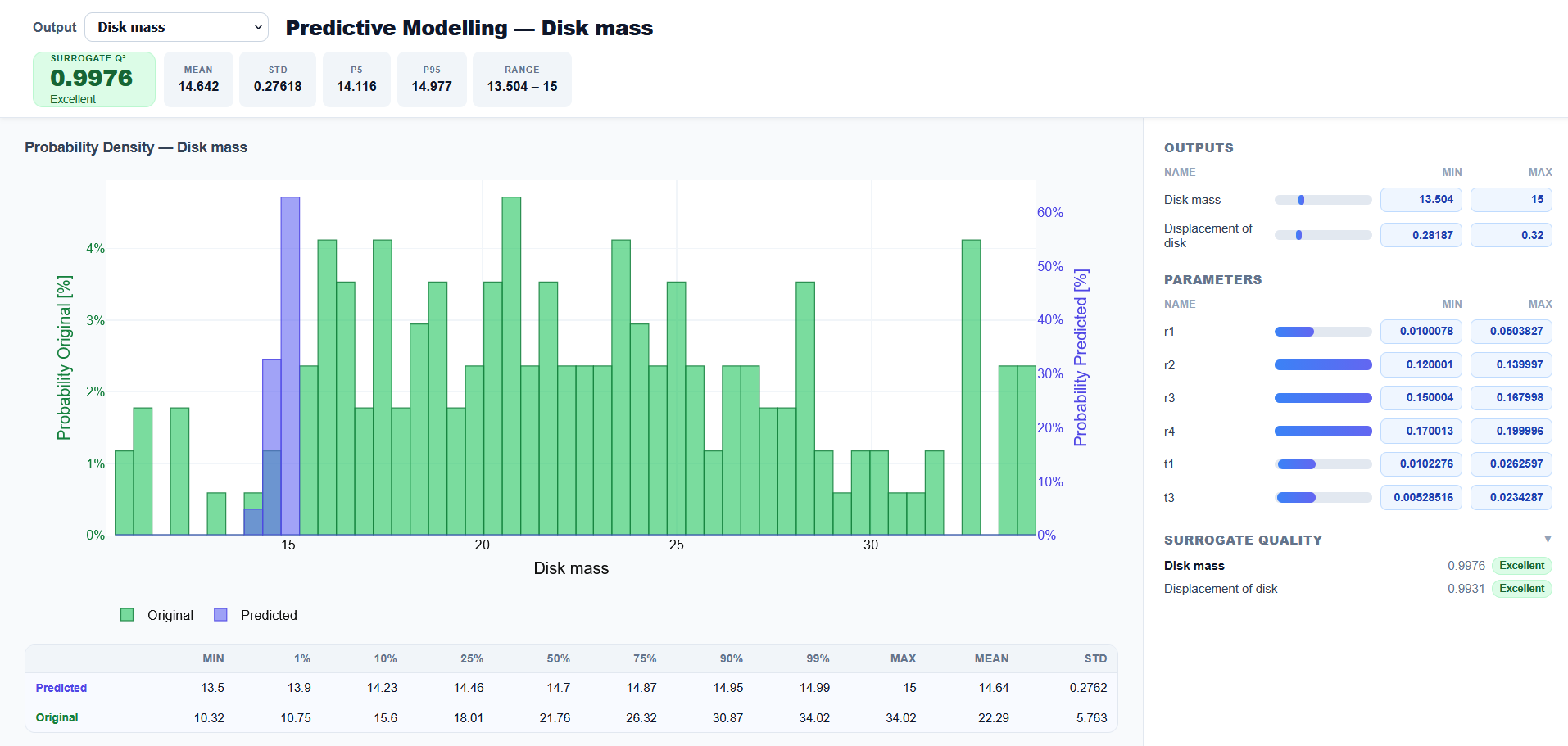
- What it does: This block works "backwards" to identify the feasible parameter ranges that produce a desired target output range. Based on a limited set of simulations, it explores the full design space to map out all valid input ranges that meet your specific goals using Monte Carlo search and the agPCE surrogate.
- Why this is useful: Reverse search is useful when you know exactly what performance you require (e.g., a specific weight or efficiency) and you need to find the right parameters to achieve it without running additional expensive simulations. It eliminates the need for manual trial-and-error in complex, high-dimensional spaces. Additionally, this block can be used as a tool for model identification and calibration, allowing you to tune your simulation parameters to match real-world test data.
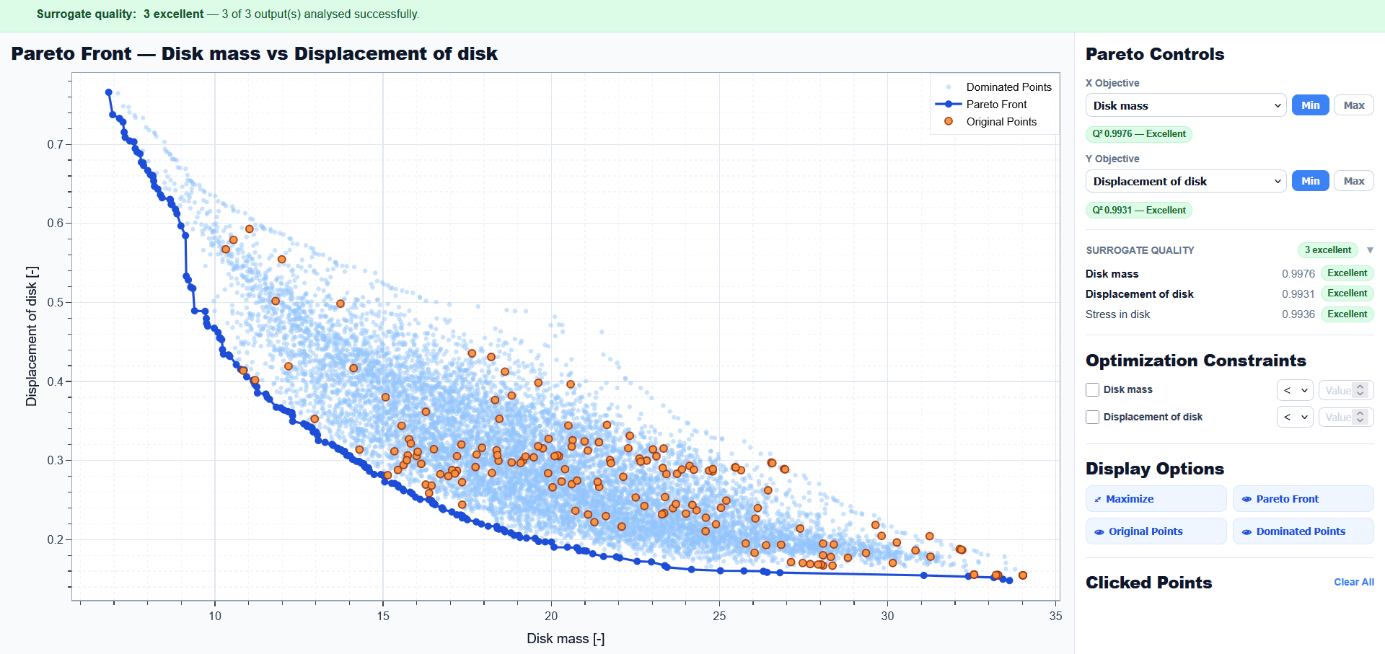
4. Pareto Frontier
- What it does: This block identifies the optimal trade-offs between competing objectives, such as cost versus performance. Using a surrogate model trained on your existing data set, it maps out all "non-dominated" design configurations where no objective can be improved without compromising another.
- Why this is useful: It gives decision-makers a clear visual overview of the best achievable designs, making it easy to explore trade-offs and select the configuration that best balances conflicting requirements, all without the need for additional simulations.
Visit the Marketplace today to discover these QUGATE blocks and take your system analysis to the next level!
Licensing and access
Please note that a dedicated licence is required to use these blocks. To gain full access to them in your pSeven Enterprise environment, please, contact QUGATE.